Genre – The Importance of Knowing which voice you are using

Hello everyone

Today I wanted to talk a bit about genre and voice for the purpose of creating the intended response.

When I was at University a large portion of my degree was spent sitting in a classroom reading other students’ work, and then providing feedback.  As you can imagine, there were lots of different styles, loads of stories and, as you might expect, varying skill levels.  By my final year, everything that I read was of a reasonable standard.  Not all of it was of interest, but the rookie mistakes were few and far between.  One day I was working my way through a pile of drafts and I found one whose title caught my eye.

Wendigo

Knowing that a Wendigo is a carnivorous, if not cannibalistic, spirit from North America I thought, “Great, a horror.”

I started reading a story about a bachelor party come hunting trip  gone horribly wrong, which made for a very good setting.  However, the tone and language read more like what I might expect from part of “The Hangover” series of movies.  It felt more like black comedy.  I was disappointed, however, it could easily have been intended as a Black Comedy and my expectations were unreasonable.  As was my responsibility,  I gave my feedback and noted that the tone was less horror and more comedy than I had expected.  I suggested, that if the writer was going for horror, they needed to change some of their language and the dialogue.  And that was that.  I never got to read the finished piece, which is a bit a shame really.  I hope the writer went on to produce a good piece of fiction.

It got me thinking.  In this case, Genre was defined by language and dialogue.  So, I started wondering, can we use this?

And the answer is, of course we can.  I attended University in an English city called Lancaster, which is about a thirty minute drive from the Lake District – a national park of hills, fells, mountains, and a lake.  Fun fact, there is only one lake in the Lake District.  The rest are Waters, Meres and Tarns.  The differences between them…are utterly irrelevant to me.  However, the Lake District is an idyllic setting of rolling landscapes, lush greenery and sparkling water.  Why am I telling you this?  Because the Lake District can also be cold, wet and blustery, isolated and dangerous.  The context of the place changes very drastically with a slight change of language.  Now, I am not for one minute suggesting that when you are writing about something grim and horrid, you simply change the background to reflect that.  That is pathetic fallacy, it is cliche.  The point I am making is that the same thing has multiple ways to describe it and the emotion evoked by differing descriptions is likely to be quite different.

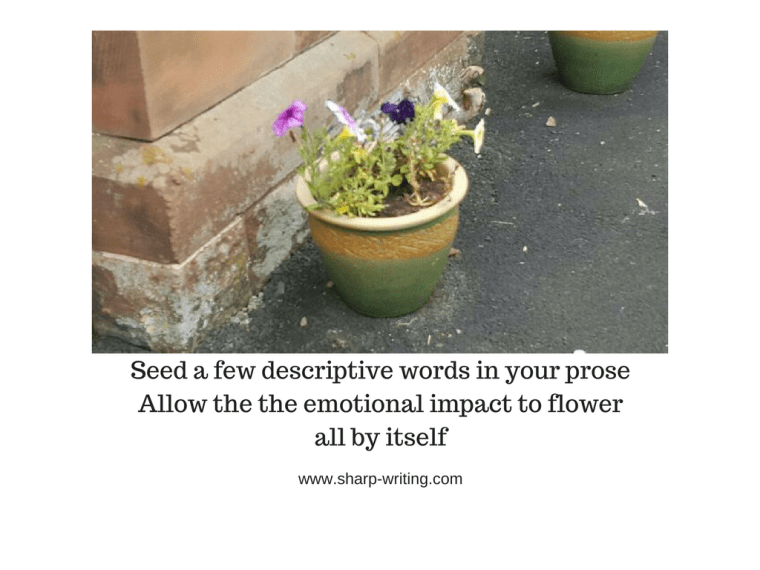
A tree can be grand or looming.  A meadow can be peaceful or silent.  Fire can be warm or destructive.  A thesaurus is your friend when looking for alternative ways of describing things, though, a word of caution.  Don’t overdo it.  You’ll probably need to learn via trial and error to find the right balance, however I would categorically state that too much description takes us into the realms of overwriting.  To use a gardening analogy, seed a few descriptive words in your prose and let the emotional impact grow in the minds of your readers.

Seed a few descriptive words in your prose  Allow the the emotional impact to flower all by itself

Use words that evoke specific responses and let the reader do the rest.  Plant too many, and they fight for light and water, and diminish one another.

I think that is how you turn your voice to the genre you want.

What are your thoughts on this?  Have I overly simplified it?  Complicated it?  Have I forgotten something crucial?  Or do you agree?  I’d love to hear from you!

The Formula for Success

Hello folks.  today I wanted to talk about something that can benefit your writing, tangentially, but is more appropriately a life lesson.  I am going to talk about my formula for success.

This is my blog post about how to harness success

Years ago, I worked in a call centre as a team leader.  It was may job, with one other person, to manage a team of nearly 40 people.  The team members had various targets including handling time of calls, and sales.  Calls came in from outside and were routed to the first available agent, which meant that whoever you spoke to on any given day was random.  I tell you this as it was where my understanding of success came from.  One morning, I was going through the figures with my co-team leader.  He was a salesman of the old school called Alan.  We were looking at our figures for the previous day’s performance and I was despairing over one team member who habitually performed on the lower end of the spectrum.  Alan and I were discussing how we might help the individual improve as we got into bother when stats were down.  I said something along the lines, “It is the luck of the calls.  What can we do?”

His response was the less polite version of, “You are talking nonsense…”

He then quantified his statement.  We looked at the individual’s performance over a longer period.  It was consistently lower than average.  We then looked at other team members.  They were consistently higher.  He then challenged me, “Is person A unlucky and person B lucky?”

I had to admit that was unlikely.  So we listened to the calls of each individual to see the difference.

Person A offered the sales, but was inconsistent.  They didn’t offer every time, and because they didn’t offer every time, it didn’t sound natural.  Person B was the opposite. They offered every time, and as a result developed a way of pitching that they were comfortable with and that people responded to.  Person B made the most of every opportunity.  And they were good with every opportunity.

This gave me my first two parts to my formula for success.

Ability

Opportunity

I realised, or perhaps I already knew but had never said it before, that being good at something increases the odds of success.  And the more times you try, the better you get at it and the better the odds you will eventually achieve your objective.  Perhaps I did understand that but never put it into a sentence before.

However, I wasn’t satisfied as that didn’t account for everything in the success equation.  Sometimes “Bad Luck” happened.  I don’t actually believe luck is a particularly useful concept as you can’t quantify it and you can’t control it.  I modified my thinking to “Sometimes, random things happen.  These could affect the outcome positively or negatively”.  That didn’t cover everything either, because sometimes there are other factors that contribute that are not random.  They are situational, they are environment and the people who can help or hinder.

I eventually developed the theory that success was a combination of ability, opportunity and circumstance.  Ability is something you can control.  You can practice your skills, your crafts and become a master.  Opportunity is something you have a lot of control over.  It is up to you if you make the most of presented opportunity.  It is up to you if you want to go looking for other opportunities.

Circumstance is a bit harder.  Some of it you can influence, for instance the location and people who can help or hinder are within your ability to influence.  Unfortunately, sometimes things just don’t work.  There are things you can’t always account for, and sometimes things will simply go awry.  However, this is not the end of the world because if you are unsuccessful, you have missed an opportunity.  There is another one and another and another if you want to make the most of it.  Circumstance may be harder to control but if you make the most of your ability and take every opportunity then you will always have another chance.

This proved to be of benefit to me recently as I managed to get a writing job that is ideally suited to me, as it is within my skillset and of interest.  I recently started freelance writing for an independent game designer, writing content for their new up and coming product.  Some people might call it luck that I landed such a well suited role for me.  I call it the result of five (or more) years effort.

Ability – I have spent years honing the craft of writing.  I graduated last year with an Honours Degree.

Opportunity – Once graduated, I did a course on proofreading and a course on blogging professionally.  I always knew that players of wargames and roleplay games were a large portion of my target audience so I made many connections in the gaming community, both in my home area and at University.  I formed positive, lasting relationships so that even after I left people still knew my name.

Circumstance – By taking the courses and building links with the community that my intended fans were from, I was able to go to the places they were and get my name and skillset known by them.  I had thought that I would be able to get a few interested people from this niche to help spread the word about anything I wrote.  I was just as happy when one of them came knocking on my door asking for my help.

Success is about ability and opportunity, or perseverance. I failed University the first time round but completed it the second. This represents success for me

So, how can this benefit you?

Well, if you want to be a published writer, then you owe it to yourself and to the reading public to be the best writer you can be.  Practice lots.  Go to writing groups.  Read blogs.  Read books on the subject.  Read books for fun.  That is your ability.

Opportunity can just as easily be described as perseverance.  It isn’t enough to talk about writing.  You have to do it.  You have to do it regularly.  And then you need to refine it until it is ready.  Then you can send it to agents.  And if you get rejected, send it to another agent.  And another and another.  Or self publish.

Your circumstance is being known by your market.  Do your readers congregate anywhere that you can participate?  Go there.  Make yourself known.  You probably don’t even want to mention your novel at this point.  You are just making people learn your name.  Do that, and you’ve achieved an emotional link with your potential fan base, so when you have something to sell, your audience is more receptive.

What are your thoughts?  Have you found any killer formulas that help you be successful?

Frankenstein – A peek behind the curtain

Hello folks, you are most welcome here.

Today, I want to talk about one of my favourite books, Frankenstein by Mary Shelley.  I should also say, this post contains affiliate links, and potentially spoilers if you don’t know the story.  I would also say that this post won’t have much in the way of creative writing advice, so much as it is intended to help the reader understand stories from a different perspective.  I found, during my time at university, that if I was able to pull a story apart and figure out what the writer was doing and how, then their tricks and skills became mine to use as I saw fit.  Anyway, I am focusing on Frankenstein and if you haven’t read it, and you enjoy horror, you really need to give it a look as it is an atmospheric, gripping and multilayered horror.

I suspect if you are reading this website, you have heard of Frankenstein, at least, and hopefully are aware that it is about a man who tries to create another man by less than natural methods, and by that I mean science and grave robbing.
The tale is set around the beginning of the industrial revolution, in Switzerland, and follows Victor Frankenstein through his life. Victor is the son of a wealthy family who develops a passion for the sciences, and as he grows older he becomes obsessed with the idea of creating a man from constituent parts. He succeeds, but when he looks into the eyes of his creation for the first time he suffers some form of nervous or psychotic break, fleeing his lab in the process.

The creature is presumed to flee, and Victor blocks the memory of the event and the creation whilst trying to carry on with his life.  His health, which he neglected in the process of creation, gradually recovers despite family tragedies and it looks like he might have a chance at a happy life.  And then his creation returns, having learned that humans are cruel.  The creature recounts the tale of his missing years, and delivers an ultimatum to Victor.

What follows is a tormented account of Victor’s life as he wrestles with the creature’s demands and the demands of his conscience.  The conflict is complicated by his responsibility to the creature as the only parent it has, and also the responsibility to the rest of the world should he comply with his creature’s demands.

This story is about Victor and his hubristic ambition.  Victor is incredibly well written and in the first chapters of the book he was a sympathetic character.   He is driven, partly by curiosity and partly by ego to discover and to challenge the unknown.  And,  as with any great tragedy this is the seed of his downfall.  In fact, Victor is an extreme egotist who challenges the natural order which, given the time period, could be interpreted as a challenge against God.  Remember, the full title of the Novel is Frankenstein: Modern Prometheus.  Prometheus stole fire, symbolic of life, from the gods and was punished for this.  Victor Frankenstein plays god creating life in death, and is ultimately punished for his arrogance.

There are a number of elements that bear further study and I will draw your attention to them, so you can do that or even deconstruct them for your own use.

Victor’s health deteriorates as he creates the monster.  It isn’t a huge leap of logic to refer to him as an Urban Gothic Necromancer, sacrificing of himself so his creature can live.  And his health is only restored when he abandons the creation, and returns to his family and more healthy pursuits and happiness.  Of course, Victor’s happiness is short lived as his life is beset tragedy, which is entirely appropriate to the undead metaphor, making Victor not only a metaphor for a Necromancer, but also a Vampire or some other form of evil parasitic spirit.

The creature, we discover, is quite capable of cruelty.  Which was hard for me to credit, given its account of the missing years.  However, I was making an error in judgement.  I was treating the creature like an adult because it could speak like one.  However, Victor’s creature was effectively a child abandoned at birth.  A child with no role model to teach it how to act, and no parent to teach it right and wrong.  As such, the creature’s psyche can be interpreted as that of an impulsive child, with no moral compass, throwing a particularly violent tantrum.

Aside from one scene, which I daresay could be explained away as a delusion, no one ever sees the creature, aside from Victor (and his victims).  Of course, the creature tells Victor he met people.  And people die at the creatures hands, but no one ever sees him.  So, another interpretation, which I find intriguing, is that there is no creature at all.  Or at least, it never lived.  In fact, the horrors are committed by Victor, who has suffered a psychotic break and now believes he has a tormentor.  In fact the tormentor, the killer, is him; desensitised to death due to his grisly excavations, perhaps his psychosis now compels him to end lives to study the process by which life leaves the mortal coil.  With this information, his next effort will be successful.  Of course, even a desensitised egocentric needs some form of psychological protection from the horrors committed and so he invents the creature;  a being ostracised by society that feels justified in his murderous urges.

Of course, if I was to share this with one of my former tutors he would tell me, “Interesting John.  So what?  You can’t prove it, so where are you going with this?”

Yes, I have had the conversation with a tutor.  It proved useful as my assignment took a new direction and got a better mark.  Anyway the purpose here is not to create a ridiculously lengthy academic study.  My point was to peel back the layers of a known story and show that there are other interpretations, some almost believable and some fantastical.  In looking at my three interpretations, I think there are probably many lessons to be learned.  I will share my thoughts, however I would then encourage you to do the same with any ideas you have.

Genres are much closer to each other than you might think.  Frankenstein is a gothic horror, however, as I noted above it wouldn’t take too much to move it into fantasy horror, or dark fantasy.

Sometimes cruelty and viciousness comes from unexpected, but perfectly understandable quarters.  One of my hobbies is playing in roleplay games, and one of the scariest characters I encountered was an utterly unpredictable child, who could be innocent one minute and a murderous psychopath the next.  Also consider, childlike is often associated with innocence, however innocence turns to horror very easily when parental guidance is removed from the equation.  This brings you to “What if” writing.  What if the child was abandoned?  What if we removed this other factor from an individual?  What impact would it have.  What if we added something, instead of subtracting?  There are countless stories to be told simply by exploring what if.

“A strong enough situation renders the whole question of plot moot. The most interesting situations can usually be expressed as a What-if question…”

Stephen King, writing in the Guardian (talking about his book On Writing )

Full Article Here

Psychology and the mind, properly employed, can give a logical explanation for the seemingly supernatural.  In fact, this is probably even more effective as a tool in horror as it has the added weight of forcing the reader to realise that it isn’t some invention of the writer, rather it is a condition that could happen to anyone.  And something like that can make a villain terrifying and sympathetic at the same time.  This is not something that should dabbled with lightly.  Study of things like psychosis, multiple personalities and schizophrenia is likely to be difficult, if not harrowing.  And you do sufferers a disservice if you misrepresent them, so if this is a route you would explore then I would suggest tread cautiously

I hope you found this of interest, and and of use to you.  These realisations have certainly helped me.

All the best.


Feedback – a Sharp Writing Guide

Hi there, you are most welcome here today.

Since we did editing last week, it is appropriate to now do feedback.  If you haven’t read my post about editing, then click on the blue text and have a look through first.  Done?  Good.

To get started, you will need more than one person.  Writing is often a solitary activity but it does require the help of others.  A pair is possible, a group of interested parties is better.  You will also need a piece of writing; between 500 and 1000 words is ideal.  You’ll need two copies of this, and the work you did for the editing post is most suitable, as you already have some thoughts on it. Failing that, any piece of writing of around 500 to 1000 words will do.  I recommend checking out the editing post as I have a number of suggestions on good etiquette.
Writing is a solo activity that requires the help of others

Right, you have your pieces of writing.  Pass one to the person to your left.  You will also be receiving a piece from the person on your right.  Now, everybody, write feedback on what you have received.  Don’t worry that we haven’t been through any useful information yet.  The purpose here is to just get people started and highlight if you have any bad habits.  Spend ten to fifteen minutes on this.

Ok, now that you have had a chance to practice some feedback, let’s have a look at a few things that can help you.  Because, if no one told you, giving feedback is hard.  Hopefully this post can help you a bit.

So, you have a piece of work from a friend.  They have (hopefully) told you what genre it is, and what they were trying to achieve.  Where do you start?

Read the thing in its entirety before doing anything.

It is all too easy to comment that something doesn’t make sense, and then to find that the answer you needed was actually later on in the piece and what confused you was actually a clever setup.

Avoid saying things like “I liked this piece…”

Saying you like a piece is always nice, but it isn’t particularly helpful for the writer or for you.  Firstly, like and dislike is a matter of taste.  You might have the best prose in the world in your hands, however if it is in a genre you hate, chances are you will hate it.  See the contradiction – how can you hate something that is the best prose in the world?

It is possible because you are looking for the wrong things.  The next thing I say is going to sound really harsh.

Whether you like a piece or not, whether you like a genre or not, is irrelevant to the process of feedback.  The process of feedback is to determine if the writer has made errors, to determine if the author achieved what they set out to do.  It is not to entertain the editor.  Too many times I have heard people in class saying they didn’t want to give feedback on a piece because they didn’t like the genre.  Tough.  Get over it.
Your enjoyment of a piece or genre is irrelevant when giving feedback

The writer can help the reader here by asking specific questions.  I listed some of helpful ones in my editing piece.

You are critiquing the writing, not the writer

This should be self-evident, however it is very important to re-iterate.  Your comments and feedback should be about what elements of writing don’t work.  Not what the writer did wrong.  It is a hard task giving, and receiving feedback.  Everyone is better served when feedback given is impersonal.

Be Specific

I cannot emphasise this enough.  In my many years of writing I have (thankfully not that often) received some useless feedback, and in many cases it was due to its lack of specificity.  An example,

“Don’t use clichés.”

That was a single note added at the end of my piece, with no explanation.  That was it.  Ok, I thought, I won’t.  Which ones are you talking about?  I hadn’t realised I had used any, or I would have avoided them (dare I say…) like the plague.  I didn’t know what the reader meant so their feedback was useless.

Another favourite of mine, and I get this frequently, is “Your sentences are too long”.

I do like long sentences.  I also like short sentences, and I like sentences of middling length.  So, that feedback on its own wasn’t helpful.  Were there extraneous words in it?  (In one case I can recall I checked.  I could chop one word without changing the meaning.  So I did).  Or did the reader simply not like long sentences?  Was the idea conveyed too complex for one sentence?  Would the pace have been better served by several short sentences? Certainly some sentences are too long, but in the case of feedback if you think there is a problem you need to say why.

An example of how the same feedback could have been useful is:

Avoid saying things like, ‘avoid clichés like the plague’.  It is an overused phrase and is therefore cliché.

That would have helped.  Another example would be to say:

That sentence repeats the same idea multiple times, and it is not necessary beyond the first and could be cut down a bit.

Where possible, or unless asked, avoid offering alternatives

Remember, the piece you are reading is not yours.  Your words may not be the best option when changing something.  Simply, specifically, highlight what is not working for you and why.  Then allow the writer to determine the right course of action.  Of course, if the writer asks for your opinion on what you would do, then by all means go ahead and offer any advice you have.  Just remember to check your ego at the door, it is their work not yours.

Check your ego at the door, we're doing feedback

And finally, answer any questions the writer gave you

It is good practice for a writer, once they have edited their work, to think of things they want the answers to and ask them of the people giving feedback.  If the writer has made that effort, do them the courtesy of answering.  They have made your job just a bit easier by doing that, so, help them out.

Ok, those are my major points for feedback.  There are probably other helpful things you can do, and if you know of any, please feel free to comment on this post.  I may even incorporate them into this work, since none of what I am sharing is new, ground-breaking or original.

Now, you have one copy of your work left.  Pass it to the person on your right, and receive one from your left and take 15 to 20 minutes (or as long as you need) to write feedback.  Then collect your piece, both of them if you haven’t already, and compare the two.  Maybe there won’t be many differences, because everyone has different abilities, and maybe there will be.  Compare the two, the second piece given is (hopefully) more helpful.  Though that is not to say the first feedback is not helpful, only that it may have been less polished.  Either way, you have two pieces of feedback now and that can only help you.

However, now I must share with you something incredibly important.

In my last post I mentioned there were four rules of editing and feedback, but I only covered the first three at that point.  They were:

First – Know what you (the writer) are trying to achieve.  This ranges from as broad as what Genre you are writing in, to what effect you want to have on a reader at a specific point.

Second – Ask those feeding back if you achieved what you intended.  People providing feedback will undoubtedly provide more, however this is the first opportunity for you to find out if you are having the intended impact.

Third – Be open to the feedback.  You may not always like what you hear, however going through the process will improve your writing and help build your resilience, which is a necessary attribute for a writer to have.

I will now tell you my fourth rule, and I believe it is probably the most important.

As the writer, you are free to ignore any feedback/advice at any time if you disagree with it, so long as you have good reason.  This rule also encompasses the rules of writing, in which I would say you are within your rights to ignore the rules of writing.  However I would not be so cavalier to do so as the rules can help inexperienced writers.  In this case my rule is about ignoring feedback and advice from others.

This seems to contradict my third rule, about being open.  It doesn’t contradict it at all.  You do need to be open to feedback, however, if after hearing your feedback and considering it you have decided it is not appropriate to make any changes based on it, then you as the writer have every right to disregard it.  And the person feeding back should not argue.  It is your piece, and sometimes the reader is wrong.  They may have missed the point of your writing, or they may have forgotten to check their ego before reading.  I have personal experience of that, where a person gave me feedback which I disagreed with.  I thanked them and explained why I wasn’t going to follow their suggestions.  They then argued with me and told me I would never be a good writer if I didn’t follow their advice.  I never sought feedback from them again.  They were not trying to help, rather they were trying to prove how clever they were.  And I still disagree with their feedback, so in that respect they failed.  Don’t fall into that trap.  If your feedback is rejected, move on.  The writer has ultimate responsibility for the success or failure of their work.  They are free to make any creative choice they choose.
You are free to disregard any feedback you recieve if you have good reason to

Ok, I think that just about wraps up what I have to say on feedback.

If this post was of use to you, don’t forget to subscribe to the blog, or even check out my hobby blog over on www.itsmorethanjustgaming.com

All the best, and see you next time

John